

Mahatma Shanti Prakash
Badey Baba,1830 -1958
Acharya Shanti Prakash Badey Baba, Fountain head of the Sarayu Sampradaya
Acharya Shanti Prakash, lovingly remembered by Acharya Shunya and her students as Badey Baba, meaning “Elder Baba,” was the great-grandfather of Acharya Shunya and one of the defining Acharyas of the lineage now known as Sarayu Parampara. Revered in Ayodhya as a Maharishi, a great seer, and honored as Paramatman, a godly soul, Badey Baba lived a life of devotion, self-inquiry, moral courage, and service.
He was born into a home shaped by Shastra and spiritual inquiry. His father, known in the household as Sadhu Samanlal and spiritually as Anubhavananda, was a scholar, devotee of the goddess, occasional public speaker, and private teacher to a few disciples at his home, who had also served in the administration of the last Mughal emperor.
Though Anubhavananda did not maintain a full-time Gurukulam, he taught and transmitted the foundational Shastra to his son. The spiritual lineage he carried was known as the Parmarthika Pantha. Badey Baba inherited this sacred current, deepened its teaching work, and gave it the name Sarayu Parampara, honoring the holy river and the spiritual soil of Ayodhya from which it arose.
His presence was so deeply felt that the neighborhood where he lived came to be known as Rishi Tola, the abode of rishis. To this day, his life stands as a bridge between ancient Vedic wisdom and the needs of a changing world.

A Seer of Ayodhya
Badey Baba lived in Ayodhya, the sacred city of Sri Rama, where his spiritual radiance became widely recognized. The people of Ayodhya revered him not merely as a scholar or teacher, but as a living rishi, one whose presence carried peace, clarity, and divine remembrance.
So deep was the community’s reverence that the neighborhood where he lived came to be known as Rishi Tola, “the abode of rishis.” To this day, this name stands as a quiet testimony to the spiritual stature of Acharya Shanti Prakash.
He did not seek fame. He lived Dharma so completely that Dharma itself announced him.
The Sarayu Awakening
Artistic recreation: In the sacred Sarayu, the young Shanti Prakash encounters Sarayu Devi, receives her diksha, and rises from near death consecrated to a life of Veda, service, and liberation.
.png)
Before Acharya Shanti Prakash gave the lineage its present name, this stream of family acharyas was known as the Paramarthikas: seekers and transmitters of Paramartha, the highest truth.
Then, in Badey Baba’s twenty-first year, the Sarayu herself claimed him.As remembered in the lineage, the young Shanti Prakash was drowning in the sacred river of Ayodhya when he entered a mysterious threshold between life and death. In that subtle realm, he encountered Sarayu Devi, the Goddess of the river, not as symbol, but as living Mother.Before her, he spoke the truth of his soul: he had received the treasure of Vedic wisdom from his parampara, but he had not yet given it back.
His life’s work was still unfinished. The Divine Mother affirmed him.He returned from that encounter transformed.From that day, Shanti Prakash lived as a householder-renunciate: outwardly present in the world, inwardly given to God, Veda, guru, service, and liberation. His life no longer belonged to personal ambition. It belonged to Dharma.Later, he named the lineage Sarayu Veda Sampradaya, honoring the river that had given him diksha and revealed the direction of his life.Thus, through Badey Baba, the earlier current of the Paramarthikas took visible form as the Sarayu Sampradaya: a living river of Veda, Devi, Advaita, Yoga, dharma, and selfless service.

When Realization Becomes Visible
Before the Sarayu awakening, the young Shanti Prakash had already been shaped by shastra, gurukulam discipline, and the sacred inheritance of the Paramarthikas. He was learned, contemplative, and marked by spiritual promise.But after his encounter with Sarayu Devi, the change in him was unmistakable.
Those who came near him felt that something profound had been revealed. His presence carried unusual stillness. His words had the force of direct knowing. His compassion deepened. His silence itself began to guide.It was then that people began affectionately calling him Paramatma Shanti Prakash. This was not a title he claimed for himself. It arose from those who experienced the divine presence shining through him.
People came to him with grief, confusion, moral struggle, spiritual hunger, and the burdens of ordinary life. He spoke with them, consoled them, awakened them, and turned their hearts toward Dharma.
His influence spread through satsang, counsel, service, and the quiet power of realized being. Even the place where he lived came to bear witness to his presence. Where he lives, the neighborhood that had ben hostorically known as Rassi Tola, associated with weavers and rope-makers, became known as Rishi Tola, “the abode of rishis.”This was more than a change of local name. It was the community’s recognition that a realized one was walking and living among them. Through Badey Baba, the light of Sarayu Devi’s diksha became visible in the world.
This title is stronger because the main subject is not the neighborhood. The main subject is realization becoming visible. Rishi Tola then becomes a supporting proof, not the whole point.

WISDOM ROOTED IN THE VEDAS
Acharya Shanti Prakash was a profound Vedic scholar and realized teacher. His wisdom flowed from the Vedas, Upanishads, Bhagavad Gita, Vedanta, Yoga, and the living practices of the rishis. He taught seekers to look beyond fear, sorrow, social conditioning, inherited shame, and spiritual ignorance.
He guided them toward the discovery of their true nature: pure, boundless, luminous, and free.His teaching was never dry philosophy. It was wisdom made alive. It gave seekers courage to live with integrity, compassion, devotion, and inner sovereignty.
For today’s world, where many feel spiritually uprooted, anxious, and divided within themselves, Badey Baba’s message remains piercingly relevant:Know the Self. Live Dharma. Serve the world. Do not be ruled by fear.
This artistic representation, inspired by a real family photograph, evokes the quiet beginnings of a life consecrated to Vidya, sadhana, and dharma.
Sarva Arogyam Sarva Mukti Health and Spiritual Liberation for All
In the early twentieth century, Badey Baba founded the Sadharan Dharma Sabha to bring the healing, ethical, and liberating knowledge of the Vedic tradition into the lives of ordinary people. Its purpose extended beyond formal religion. It sought to connect the wider community with the Vidyas that support sarva arogyam, well-being at every level, and sarva mukti, freedom from suffering, ignorance, and limitation.
Its work held special significance in colonial India. At a time of political subjugation, social fragmentation, economic hardship, and declining confidence in India’s own knowledge traditions, the Sabha encouraged a return to the wisdom of the rishis. This revival of Vedic learning quietly restored cultural dignity and strengthened the spirit of self-determination.
For Badey Baba, mukti was both inward and lived. It referred to liberation through Self-knowledge, but also to freedom from fear, ill health, helplessness, social degradation, and dependence. The Sabha therefore addressed the whole human being: body, mind, conduct, community, and soul.
Its service reached spiritual aspirants, householders, women, children, the poor, the sick, and the socially neglected. It offered Shastra study, meditation, home remedies, knowledge of medicinal herbs, free Ayurvedic medicines, support during epidemics, yajnas, material assistance, and, at times, even cows to sustain vulnerable households.
Under Badey Baba’s leadership, the Sabha became an expression of Vedic wisdom in action. It united spiritual knowledge with social responsibility, seeking to restore health, refine conduct, uplift communities, and awaken both inner freedom and cultural self-respect.

An original photograph from a gathering of the Sadharan Dharma Sabha in 1932. Badey Baba is seated above the assembled members of the Sabha in meditative composure, presiding over the gathering. The photograph has been preserved in its original form, without alteration.
Satang: The Living Heart of the Lineage
Badey Baba’s home in Ayodhya was a seat of satsang. Respected sadhus, seekers, and students came to sit in his presence, receive sacred teachings, and reflect upon the truths of dharma, Gita, and Self-knowledge.
This rare lineage image shows Badey Baba seated with his toli of sadhus. Their presence reminds us that his wisdom was not confined to family memory. It was recognized, sought, and received by the sacred community of his time. That living current continued through Baba, Acharya Ayodhya Nath, and continues today through Sarayu Parampara. Badey Baba’s satsangs drew hundreds of seekers.
People came not only to hear teachings, but to receive the living fire of Vedic wisdom.His gatherings were known for scriptural depth, spiritual force, devotion, and direct guidance. Saints, seekers, householders, students, and community members gathered in his presence, drawn by the rare combination of scholarship, realization, compassion, and fearless truth.
In the Sarayu Sampradaya, satsang has never meant a casual spiritual talk. It is a sacred meeting in Truth. It is where the guru’s realization, the scripture’s authority, and the seeker’s longing meet.
Today, Acharya Shunya continues this satsang tradition for modern seekers across the world. Through her, the same current of Vedic truth flows as living transmission, not merely information.
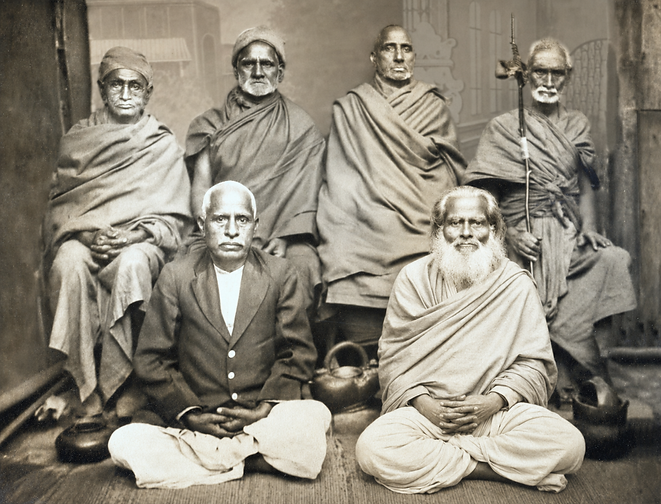
A rare original lineage photograph, lightly restored for clarity, showing Badey Baba, Acharya Shanti Prakash, seated front, right, with his toli of sadhus in Ayodhya. Many respected sadhus came to attend his satsang and receive the light of his scriptural wisdom.
Aarogya Mandala
The Nine Seeds of Living Health
In the early twentieth century, during a period of recurring drought, rural distress, and colonial neglect in the United Provinces, Badhe Baba carried out a remarkable work of Ayurveda seva. He walked from village to village, carrying nine medicinal seeds chosen for the actual sufferings of rural families: fever, exhaustion, digestive trouble, women’s weakness, swelling, sleeplessness, wounds, and despair.
These seeds included Ayurvedic plants such as ashwagandha, kalmegh, punarnava, apamarga, isabgol, chandrashura, sarpagandha, akarkara, and bhringaraj.Badhe Baba especially entrusted this knowledge to village women. He taught them how to grow, protect, and use these plants so that every household could become less dependent on distant physicians, costly medicines, or colonial systems that had failed the poor.He did not charge for the seeds or the teaching. He walked as a sevaka, accepting only the food, shelter, and affection of the people he served.
This work became known as Aarogya Mandala, a circle of health rooted in Ayurveda, seva, and the healing intelligence of the earth.
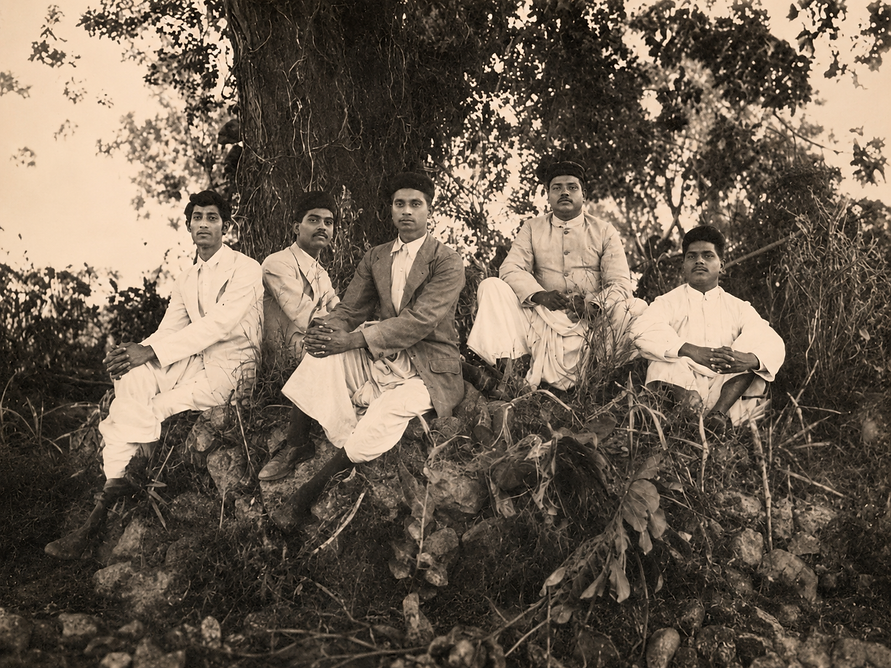
A rare original photograph of Badhe Baba’s Aarogya Mandala volunteers, circa 1936. These volunteeers and student sevakas helped carry medicinal seeds and Ayurveda-based healing knowledge into village homes across Uttar Pradesh
and surrounding regions.
The Adi Bhagavad Gita: Badey Baba’s Sacred Compilation
Badey Baba's seva through the Arogya mandala came into focus esocually through the early twentieth century, during a period of recurring drought, rural distress, and colonial neglect in the United Provinces. Badey Baba and his student volunteers taught the women how to grow, protect, and use these plants so that every household could become less dependent on distant or unavailable physicians, costly medicines, or colonial systems that had failed the poor farmers

The Adi Bhagavad Gita
Badey Baba was also an esteemed compiler and guardian of sacred knowledge. He is remembered as the first known compiler of the 84-verse Adi Gita, a sacred text cherished within the lineage as a concentrated stream of Gita wisdom.
In this text, Badey Baba calls sincere seekers toward direct illumination: “Be a true seeker after Truth, and the light will then flash upon you, not only from books and sages of this world but also from your own inner intuition.”This teaching reveals the heart of his path. Books are sacred. Gurus are sacred. Sages are sacred.
But the final recognition must awaken within one’s own Self.Badey Baba did not want seekers to remain dependent, frightened, or spiritually passive. He called them toward direct knowing.

A Grihasta Sadhu
Acharya Shanti Prakash seated among his grandchildren and the children of devotees: a rare glimpse of the grihastha sadhu ideal in the Sarayu Parampara.
Badey Baba embodied the rare ideal of the grihastha sadhu: one who remains within the householder world while inwardly belonging only to God, Dharma, and Self-knowledge. Widowed before the age of thirty, Acharya Shanti Prakash did not choose to remarry. Nor did he abandon family life. Instead, he lived a subtler and more demanding renunciation. He remained present within the family, but not as a man bound by possession, attachment, or personal ambition. His inner life belonged to tapas, Veda, satsang, service, and liberation. To his sons, he was not merely a father.
He was an Acharya. He guided them through discipline, example, affection, and shastra. In his presence, the home became more than a household. It became a living gurukulam, where children, sons, relatives, and disciples received the fragrance of dharma through daily life.This rare photograph offers a glimpse of that world: Badey Baba seated among his grandchildren and the children of his devotees.
His life reveals a profound truth of the Sarayu Parampara: renunciation does not always mean leaving relationship. At its highest, it means freedom within relationship, and the power to illumine family life with the light of moksha.
A Life Given to Vedanta
Bade Baba wrote extensively on Vedanta, dharma, spiritual practice, and the responsibilities of human life. For several years, he also served as editor of Vyavaharika Vedanta, a magazine published by him, devoted to bringing Vedantic wisdom into the realities of everyday living.
This historical image, slighly reconstructed for clarity, evokes Acharya Shanti Prakash in his later years, absorbed in the quiet discipline of his scholarship in Advaita Vedanta: seated among books, writing by hand, preserving and transmitting the teachings of the parampara through the written word.

A Lineage Sustained Through Seva
Alongside his son, Ayodhya Nath,
Bade Baba’s work was supported by devoted householders, students, volunteers, and well-wishers who offered their time, labor, and resources in service of the teachings and social service projects led by Acharya Shanti Prakash, such as the Arogya Mandala.
They helped receive visitors, organize gatherings, care for sacred spaces, and meet the practical needs of the growing spiritual community. Through their seva, devotion became action, and the work of the lineage was carried forward.
This original photograph was taken toward the end of Bade Baba’s life, likely in the late 1950's.

